How to Start a Self Care Routine at Home: 10 Simple Ideas
If you have been meaning to take better care of yourself but every routine you find seems to need a free hour, a bathroom shelf of products, or a day spa budget, this guide is for you. Learning how to start a self care routine at home is not about adding a second job to your day. It is about a few small, repeatable things — most of them free, most of them done in ten minutes or less — that help you feel a little more rested, a little more settled, and a little more like yourself.
Table of Content
- What Self-Care Actually Is (and What It Is Not)
- The 10 Simple Self-Care Ideas
- For Your Body
- Idea 1: A Morning Stretch and Daylight Start
- Idea 2: A Short Daily Walk
- Idea 3: A Simple Evening Skincare Wind-Down
- For Your Mind
- Idea 4: A Five-Minute Brain Dump
- Idea 5: A Screen-Free Pocket
- Idea 6: One Small Enjoyable Thing, On Purpose
- For Your Home Environment
- For Connection and Rest
- Building Your Routine: Three Sizes for Three Kinds of Day
- Attaching Habits to Things You Already Do
- A Simple 7-Day Starter Plan
- When Days Get Missed: Keeping It Guilt-Free
- When Self-Care Is Not Enough
- Frequently Asked Questions
- What is the easiest self-care routine to start with?
- How much time does a self care routine need each day?
- What if I have no money to spend on self-care?
- How long does it take for a self care routine to become a habit?
- What should I do on days when I have no energy at all?
- Conclusion
That is exactly how this guide is organized. First, we will clear up what self-care actually is — the everyday version looks nothing like the advertisements. Then come ten simple ideas that fit into normal life at home, each with a short how-to you can do in 5 to 20 minutes. After that comes the part most guides skip: how to shape those ideas into a routine that survives busy days and low-energy days, in three different sizes — plus a simple 7-day plan to start without pressure.
Nothing here requires special equipment, a big budget, or a personality transplant. Pick two or three ideas that sound genuinely pleasant rather than impressive, start small, and let the routine grow at the pace your real life allows.
What Self-Care Actually Is (and What It Is Not)
Self-care has been turned into a marketing category, which is a shame, because the real thing is much plainer and much more useful. At its core, self-care is the ordinary, unglamorous maintenance that keeps a person going: sleeping enough, eating regularly, moving a little, washing, resting, staying in touch with people, and giving your mind a chance to switch off. It is closer to brushing your teeth than to a luxury treat — not exciting, but quietly essential, and noticeable mainly when you stop doing it.
Just as useful is knowing what self-care is not:
- It is not a shopping category. A routine built on buying things collapses the moment money is tight. The version in this guide runs on what your home already has: water, daylight, a chair, a phone, a notebook.
- It is not a spa day. A bath can be lovely, but one monthly soak does not balance six weeks of skipped sleep. Self-care works through small things repeated often, not grand gestures repeated rarely.
- It is not a reward for finishing everything. If care only happens after the work, the house, and everyone else’s needs are fully handled, it will happen approximately never. It belongs in the middle of ordinary days, not at the end of perfect ones.
- It is not another performance. A routine you have to photograph, track perfectly, or feel guilty about is a chore wearing a costume. The right routine makes your day slightly easier, not slightly more judged.
- It is not a cure-all. Good everyday habits support your wellbeing, but they are not a treatment for illness, and this guide will point you honestly toward professional help in the places where habits are not enough.
A practical test for any idea: does it leave you a bit more rested, fed, calm, or connected — and could you repeat it on an ordinary Tuesday? If yes, it is self-care. If it mainly leaves you poorer or more behind, it is marketing.
One more idea before the list. Think of your energy like a phone battery: some days start at 90%, some at 25%. A good routine is not one rigid sequence but a short menu you draw from at whatever charge you woke up with. That is why this guide builds your routine in three sizes — a normal-day version, a five-minute busy-day version, and a one-tiny-thing version for days when even five minutes feels ambitious.
The 10 Simple Self-Care Ideas
The ten ideas below are grouped into four areas: your body, your mind, your home environment, and connection and rest. You do not need one from every group on day one. Most people find two or three that fit immediately — start there.
For Your Body
Idea 1: A Morning Stretch and Daylight Start
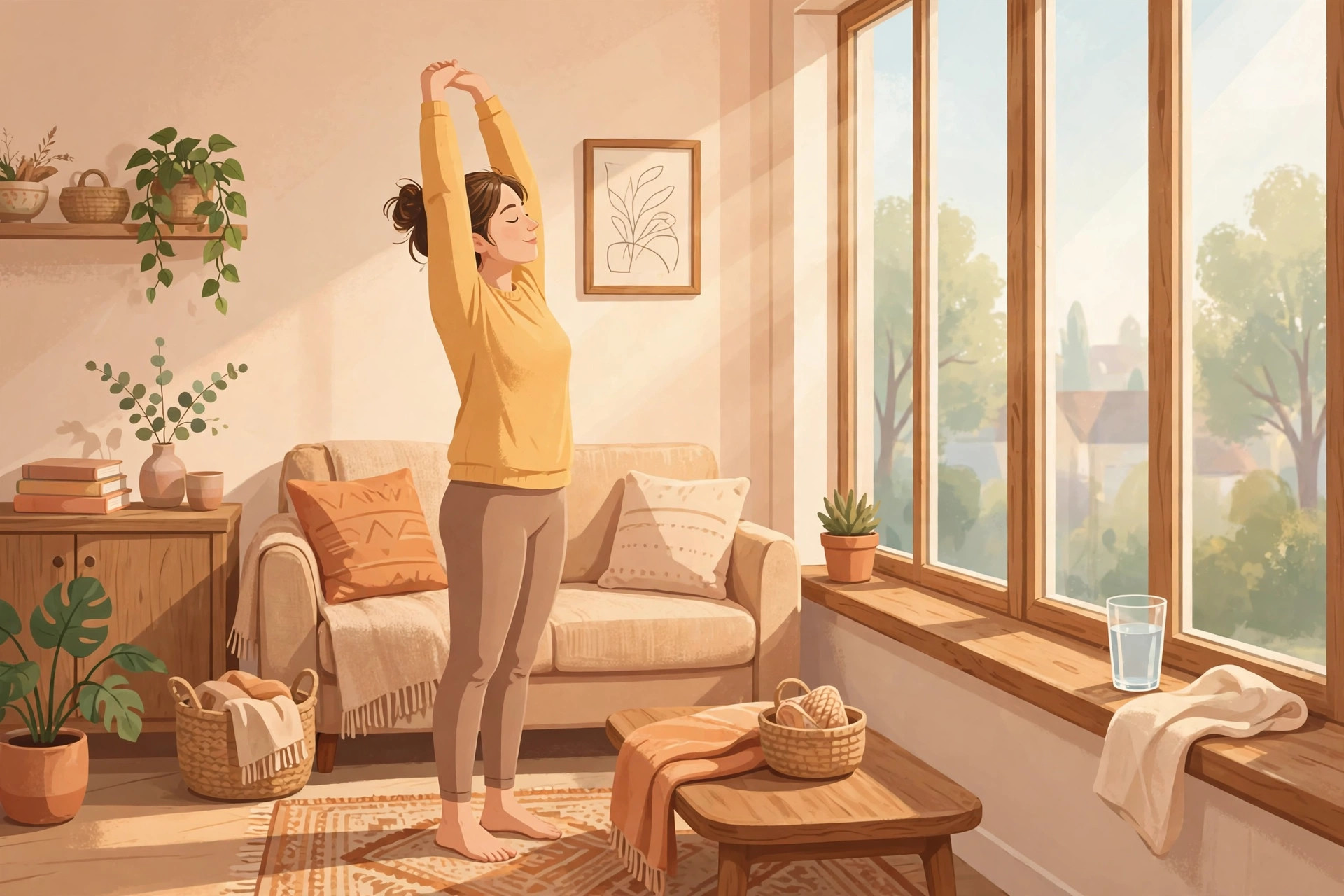
What it is: Five to ten minutes of gentle movement soon after you get up — reaching, rolling your shoulders, easing into the day — ideally with some daylight on your face, by a window or stepping outside briefly. Morning light and movement are the simplest way to tell your body the day has started.
How to do it, step by step:
- Before your phone, drink a glass of water. Overnight, you lose water just by breathing; the glass is a small, kind reset.
- Stand in the brightest spot in your home and move slowly through a few basic stretches: arms overhead, gentle side bends, shoulder rolls, a slow forward fold. Nothing should hurt; “gentle pull” is the ceiling.
- Match each movement to slow breaths — in as you reach, out as you release.
- If you can, stand by an open window or step outside for a minute or two of real daylight.
Time needed: 5–10 minutes. If you want a guided sequence to follow, our full guide on how to start a morning stretching routine for beginners walks through a complete beginner routine step by step.
Idea 2: A Short Daily Walk
What it is: A walk around your block, your street, or even laps of your home and garden — ten to twenty minutes of easy movement. Walking is the most underrated item on this list: no kit, no cost, no skill curve, and it pairs with daylight, fresh air, and a change of scene all at once.
How to do it, step by step:
- Attach it to something that already happens — after lunch, after the school run, while dinner cooks. (Attaching habits to existing cues is the engine of this whole guide; there is more on it below.)
- Keep the bar low: out the door counts. A ten-minute walk you actually do beats the forty-minute one you keep postponing.
- Leave your phone in your pocket for at least the first half, and let your eyes rest on things far away — rooftops, trees, the end of the street.
- On days when going out is impossible, walk indoors: put on music and do laps while you tidy, or march gently on the spot during a TV show.
Time needed: 10–20 minutes, or 5 on a squeezed day. For a fuller plan — how to build the habit week by week and stay safe and comfortable — see our guide on how to start a walking routine for beginners.
Idea 3: A Simple Evening Skincare Wind-Down
What it is: A short, basic cleanse-and-moisturize routine in the evening — not a twelve-step ritual, just two or three steps done slowly, as a way of washing the day off and signaling to yourself that work is over. The value is as much in the pause as in the products.
How to do it, step by step:
- Wash your face with lukewarm water and a gentle cleanser if you use one — sixty seconds, no scrubbing.
- Pat dry and apply a plain moisturizer while your skin is still slightly damp.
- Add sunscreen in the morning rather than the evening if you spend time outdoors; that is the one daytime step worth keeping.
- Do it at the sink slowly, without a podcast or video playing. Two quiet minutes count as rest, too.
Time needed: About 5 minutes. If you would like the fuller beginner version — what order to apply things in and how to choose simple products without overspending — our guide on how to build a simple skincare routine for beginners covers it in plain steps.
For Your Mind
Idea 4: A Five-Minute Brain Dump
What it is: Writing down everything currently looping in your head — tasks, worries, reminders, half-formed thoughts — onto paper or a notes app, without organizing any of it. The point is not the list; it is moving the noise out of your head and onto a surface where it can sit quietly instead of following you around.
How to do it, step by step:
- Set a timer for five minutes. The timer matters: it turns an endless spiral into a small, finished task.
- Write in any order, in fragments, in bad handwriting. Nobody will ever read this but you.
- When the timer ends, circle the one item that would make tomorrow feel lighter, and leave the rest for another day.
- Close the notebook. The thoughts are stored; your head is allowed to stop rehearsing them.
Time needed: 5 minutes. Especially good in the evening, when tomorrow’s list tends to start shouting at bedtime.
Idea 5: A Screen-Free Pocket
What it is: One small, deliberate stretch of the day — ten to twenty minutes — with no phone, no TV, and no feed. Not a digital detox, not a rule for life: just one pocket where your attention belongs to something slower, like a cup of tea by the window, a chapter of a book, music, or simply sitting outside.
How to do it, step by step:
- Choose the pocket in advance — the first ten minutes after lunch, or the last twenty minutes before bed are the easiest to protect.
- Put the phone in another room, not face-down beside you. Distance works; willpower doesn’t.
- Fill your hands with something simple: a warm drink, a paper book, a puzzle, watering plants.
- Expect the first two minutes to feel itchy. That itch is normal, passes quickly, and is usually replaced by a noticeably quieter head.
Time needed: 10–20 minutes. If evenings are your only quiet time, this pairs naturally with the evening ideas in this guide.
Idea 6: One Small Enjoyable Thing, On Purpose
What it is: Choosing — deliberately, not as a leftover — one small thing you genuinely enjoy, and doing it for ten to fifteen minutes: a favorite song played loud, a chapter of a novel, a few rows of knitting, a crossword, sitting in the sun with coffee. It sounds too simple to count, which is exactly why people skip it, and exactly why it works: it puts a small patch of the day back under your own authorship.
How to do it, step by step:
- Make a short list, somewhere visible, of small things you actually enjoy — not things you think you should enjoy. Be honest; “watching birds from the kitchen window” is a perfectly good entry.
- Pick one each day, ideally at a set moment, like after lunch.
- When you do it, do only it. The enjoyment is the task; it does not need to be productive, educational, or improved.
- If guilt shows up, note that ten minutes is roughly one percent of your waking day. You are allowed one percent.
Time needed: 10–15 minutes.

For Your Home Environment
Idea 7: The Ten-Minute Reset
What it is: A short, timed tidy of one small area — one surface, one corner, one drawer — that returns it to “fine.” Not deep cleaning, and not the whole house: just the particular patch of mess your eyes keep landing on. A calmer corner genuinely lowers the background noise of a home day.
How to do it, step by step:
- Pick the smallest possible target: the chair that collects clothes, the bathroom counter, the entryway pile.
- Set a timer for ten minutes and work only on that spot — everything leaves it, gets binned, or gets a home.
- When the timer rings, stop, even mid-task. The rule of stopping on time is what keeps this kind forever instead of letting it grow into a full clean.
- Make the finished spot slightly nicer if you can: a plant moved onto it, a candle, the good mug left ready for morning.
Time needed: 10 minutes. One spot a day quietly transforms a home over a few weeks, without a single exhausting cleaning marathon.
Idea 8: Make One Corner Yours
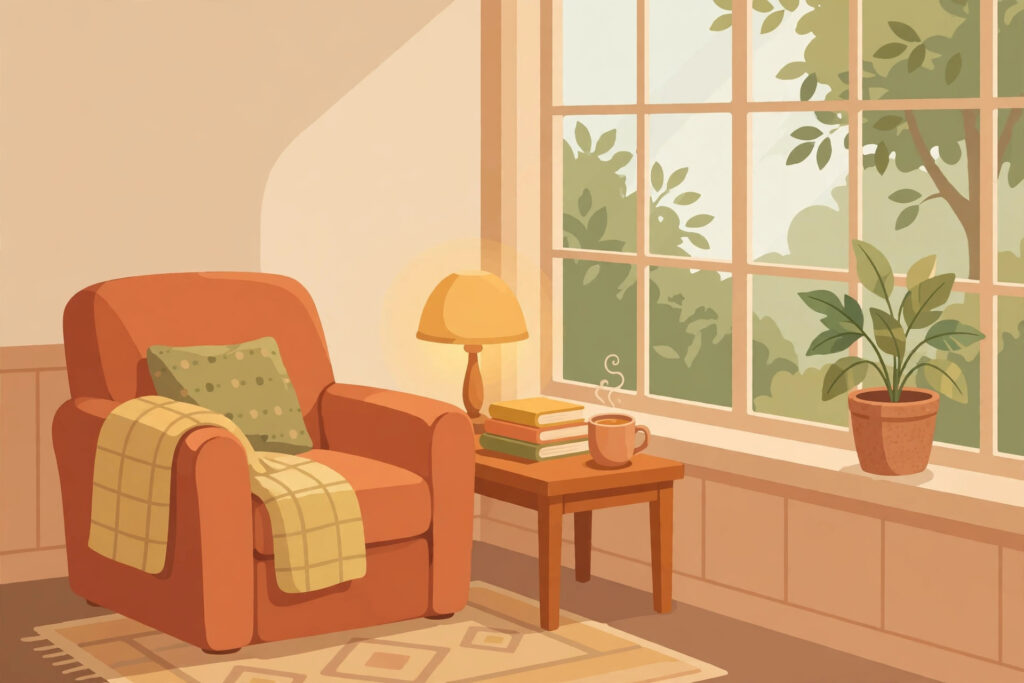
What it is: Claiming one small, specific place in your home — a chair, a windowsill, a corner of the sofa — as your rest spot, with the two or three things that make it feel good kept there: a cushion, a blanket, your book, a lamp you like. Having a designated place lowers the effort of resting to almost zero, because the decision of where is already made.
How to do it, step by step:
- Choose the spot by where you naturally drift when tired, not by where looks best.
- Clear it of everything that belongs to chores — no mail pile, no laundry basket. It has one job.
- Add comfort deliberately: something soft, something warm to drink nearby, light you can adjust.
- Use it only for restful things for the first couple of weeks, so your brain starts associating the corner with switching off.
Time needed: 15–20 minutes to set up once; then it serves you in every future five-minute pause.
For Connection and Rest
Idea 9: One Real Conversation
What it is: A short, genuine exchange with another person — a ten-minute phone call with a friend, a proper chat with a family member without phones on the table, a voice note exchange that is more than logistics. Connection is a basic need, not a bonus, and small regular contact does more for most people than the occasional big social event.
How to do it, step by step:
- Pick one person and one low-effort format: a walk-and-talk call, tea with whoever is home, a weekly voice-note swap.
- Ask one real question — “what’s been on your mind this week?” — and listen to the answer without fixing anything.
- Share something real back. Connection is the exchange, not the audience.
- Put the next one in the calendar loosely, so it survives busy weeks without effort.
Time needed: 10–20 minutes. On days when people are too much, this is the first idea to skip — rest, below, is the substitute, not a failure.
Idea 10: A Deliberate Rest Break
What it is: Rest chosen on purpose, in the middle of the day, before you crash — lying down for fifteen minutes, sitting with your feet up and eyes closed, or a short nap if naps work for you. This is the idea people resist most, because rest feels like it must be earned. It does not. Rest is one of the inputs that makes the rest of your life function, and treating it as scheduled maintenance rather than collapse changes how the whole day feels.
How to do it, step by step:
- Schedule it like an appointment — after lunch is the natural dip for most people.
- Set a timer for 15–20 minutes so you can let go instead of clock-watching; a short rest leaves most people clearer, while long daytime naps can leave some people groggy.
- Darken the room a little, loosen anything tight, and let your mind wander without a screen.
- When the timer rings, get up slowly, get some light and water, and notice the difference rather than sprinting back into the noise.
Time needed: 15–20 minutes.
Building Your Routine: Three Sizes for Three Kinds of Day
Here is the part that makes a routine survive contact with real life. Most routines fail not because the ideas are wrong but because they come in only one size — the size that fits a good day. Then a busy day arrives, the routine is skipped, guilt moves in, and within a week the whole thing is abandoned. The fix: decide in advance what your routine looks like at three sizes. Then a hard day does not break the routine; it just selects a smaller version of it.
The normal-day version (about 20–30 minutes total). This is your standard day: two or three ideas, spread across the day rather than stacked into one block. A typical normal day might be the morning stretch (Idea 1) after waking, the ten-minute reset (Idea 7) after lunch, and the evening skincare wind-down plus a brain dump (Ideas 3 and 4) before bed. Notice the pattern — a little for the body, a little for the space, a little for the mind, each attached to a moment that already exists in your day.
The busy-day version (5 minutes). On days when everything is spoken for, the whole routine is one five-minute thing, chosen from the fast end of the list: the brain dump, the glass-of-water-and-daylight moment from Idea 1, or a five-minute walk around the block. Five minutes is not a compromise or a cheat — it is the thread that keeps the habit alive until normal days return, and habits that survive busy weeks are the only kind worth having.
The low-energy-day version (one tiny thing). Some days start empty: poor sleep, a heavy week, a body that wants the sofa. On those days, the routine is a single tiny act of care, as small as it honestly needs to be — drinking a glass of water slowly, washing your face, opening the curtains and standing in the light for a minute, stepping outside for three breaths of fresh air. Tiny is not nothing. On a low day, one small kind thing, done on purpose, is the entire routine — and doing it counts fully.
Decide your three versions now, while you feel fine, and write them where you will see them. Deciding once, in a calm moment, means on a hard day you do not have to negotiate with yourself — you just follow the version matching the day you are having.
Attaching Habits to Things You Already Do
The single most reliable trick in this guide: do not schedule self-care by the clock. Attach it to something that already happens every day. Psychologists sometimes call this habit stacking; you can just call it piggybacking. “After I pour my morning coffee, I will stretch by the window.” “After lunch, I will take my ten-minute walk.” “After I brush my teeth at night, I will do my five-minute skincare.” The existing habit becomes the reminder, which means the routine needs no alarms, no apps, and no willpower spent on remembering.
A few pairings that work well for the ideas in this guide:
- Kettle or coffee maker brewing → your stretch and daylight moment; the wait becomes the ritual.
- Lunch ending → your walk, or your ten-minute reset on days when walking is impossible.
- A regular TV show or podcast → your screen-free pocket can sit right before it, or your enjoyable-thing time can ride along with it.
- Teeth brushing at night → skincare, then the brain dump by the bed.
- Getting into bed → one page of a book, lights out at a consistent time.
Start with one attachment, not five. One pairing, practiced for a week, is worth more than a beautiful plan covering the whole day. When the first pairing feels automatic — when you reach for the stretch because the kettle is on — add the next one.
A Simple 7-Day Starter Plan
Here is a gentle first week. Each day adds at most one small thing, and Day 7 adds nothing at all. If a day goes sideways, skip to the next day without doubling up — this plan is a path, not a contract.
- Day 1: Choose your spot. Set up your corner (Idea 8), and write down your three routine sizes — normal, busy, and low-energy — on a note you’ll pass daily.
- Day 2: Add the morning piece. Glass of water, stretch, daylight (Idea 1), attached to whatever starts your day.
- Day 3: Add one body idea. A short walk after lunch (Idea 2), or your first evening skincare wind-down (Idea 3) — whichever sounds easier.
- Day 4: Add one mind idea. Five-minute brain dump (Idea 4) before bed, or a screen-free pocket (Idea 5) after a meal.
- Day 5: Add the environment piece. One ten-minute reset (Idea 7) of the spot that has been bothering you most.
- Day 6: Add people or rest. One real conversation (Idea 9), or a deliberate 15-minute rest (Idea 10) — go where the week has left you emptier.
- Day 7: Repeat whichever day felt best, or do the low-energy version on purpose to prove to yourself that it counts. Look back at the week and notice what actually helped — that, and not anyone’s list, is the beginning of your routine.
When Days Get Missed: Keeping It Guilt-Free
You will miss days. Everyone who has ever kept a routine for more than a month has missed days — illness, visitors, deadlines, weather, life. The routine is not broken by a missed day; it is broken only by the story you tell yourself about the missed day. A few ground rules protect against that:
Never miss twice on purpose — but never punish once, either. If yesterday vanished, today is a low-energy-version day by default. One tiny thing, then the thread is unbroken and the guilt has nothing to feed on.
Shrink, don’t skip. If the normal version feels like too much, that feeling is information: today is a five-minute day. The routine bends so it does not break.
Judge by the week, not the day. Look at any seven days and ask “did I care for myself most days, in some size?” That is the real measure. Four good-enough days out of seven is a routine that is working.
Notice what the missed days have in common. If every miss is a Tuesday, the routine is not the problem — Tuesday is overloaded, and Tuesday simply gets the five-minute version by design. Adjust the routine to fit your life, never the other way round.
Above all: this is care, not homework. The moment it becomes a source of dread or self-criticism, it has stopped being self-care, and the kindest correct move is to make it smaller and softer until it feels like a gift again.
When Self-Care Is Not Enough
Everything in this guide is general, everyday support — the maintenance layer of a life. But it has honest limits, and it matters to say so plainly: if a low mood, constant worry, or broken sleep has lasted for weeks, or has started to affect your daily life, your work, or your relationships, a routine is not the right tool for that, and you deserve proper support instead.
Talking to a doctor or a mental-health professional in that situation is not an escalation or a last resort — it is simply the next sensible step, the way you would see someone about a knee that kept hurting. Asking for support is a strength, not a failure, and it is itself an act of self-care — arguably the most important one in this article. Resources like the NHS’s Every Mind Matters and the Mental Health Foundation offer calm, practical guidance on everyday wellbeing and on recognizing when to get more help, and HelpGuide has gentle, readable introductions to many common concerns. If any of this sounds familiar, please reach out sooner rather than later.
A note on this article: everything here is general information about everyday wellness habits, shared for interest and encouragement. It is not medical advice, and it is not a substitute for guidance from your own doctor or another qualified professional who knows your situation. Please read our full Disclaimer for how we handle health-related topics on this site.

Frequently Asked Questions
What is the easiest self-care routine to start with?
The smallest one you will actually repeat. For most beginners, that is two pieces: a five-minute morning start (water, stretch, daylight) and one five-minute evening piece (skincare or a brain dump). That is ten minutes a day, attached to waking and bedtime, and it covers body and mind. Run it for two weeks before adding anything; a routine that survives its second week has a real chance of becoming a habit.
How much time does a self care routine need each day?
Less than you think. The normal-day version in this guide totals about 20–30 minutes spread across the whole day — never in one block — and the busy-day version is five minutes. Consistency does far more than duration: five kind minutes daily will change how your weeks feel far more than a two-hour ritual you manage twice a month.
What if I have no money to spend on self-care?
Then you are in the majority this guide was written for. Nine of the ten ideas here are completely free — walking, stretching, writing, resting, tidying one corner, talking to a friend — and the tenth (skincare) needs nothing fancier than a basic cleanser and moisturizer, or just water and a gentle wash. A routine that depends on purchases is fragile; a routine that depends on small repeatable actions is not.
How long does it take for a self care routine to become a habit?
It varies widely from person to person — a few weeks for some habits, a few months for others — and missing a day here and there does not undo the process. A sensible expectation: the first week feels deliberate, the third or fourth week starts to feel oddly automatic, especially where you have attached an idea to an existing cue like the kettle or your toothbrush. Judge progress by how rarely you have to talk yourself into it.
What should I do on days when I have no energy at all?
Use the low-energy version, and use it without negotiation: one tiny act of care — a slow glass of water, washing your face, standing in daylight for a minute. That is the whole routine for that day, and it counts. If low-energy days start becoming most days and persist for weeks, though, please read the “When Self-Care Is Not Enough” section above — that pattern is worth discussing with a doctor, and getting support is a form of self-care too.
Conclusion
Starting a self care routine at home is not a project, a purchase, or a personality change. It is a handful of small things — a stretch in the morning light, a short walk, five honest lines in a notebook, one calm corner, a rest taken on purpose — repeated gently until they become simply how your days go. Build it in three sizes, attach it to things you already do, and let missed days be weather, not verdicts.
Start tonight, if you like, with the smallest possible version: wash your face slowly, write down one line about the day, and let that be enough. Tomorrow, the kettle can remind you about the stretching. Small, kind, and repeated — that is the whole secret.
You will find more gentle, practical guides like this one in our Health and Personal Care category, all written for real days at home — busy ones, quiet ones, and everything in between.