
How to Start a Walking Routine for Beginners: A Simple 4-Week Plan
Walking might be the friendliest exercise ever invented. It needs no gym membership, no equipment beyond a decent pair of shoes, no special skills, and no recovery days spent regretting your life choices on the stairs. If you are wondering how to start a walking routine for beginners, the honest answer is reassuringly small: you start with five to ten minutes a day, at a pace where you can still chat, and you build from there — gently, week by week — until a daily half-hour walk feels like a normal part of your life rather than a project.
Table of Content
- Why Walking Works So Well for Beginners
- Before Your First Walk: A Short Safety Check
- What You Actually Need: Shoes and Clothing Basics
- Walking Form: Posture, Arms, and Stride
- Finding Your Pace: The Talk Test
- Choosing Routes and Staying Safe Out There
- Your Simple 4-Week Walking Plan
- Making It Stick: Cues, Tracking, and Small Tricks
- Bad-Weather and Low-Energy Days: The Backup Plan
- A Quick Health Note Before the Questions
- Frequently Asked Questions
- How long should a beginner walk each day?
- Is walking 30 minutes a day enough exercise?
- What is a good walking pace for a beginner?
- Should I walk every day, or take rest days?
- What if I miss a week of my walking routine?
- Conclusion
That is exactly how this guide is organized. You will find a simple four-week plan that takes you from short, easy strolls to a comfortable 30-minute walk, plus the basics that make those walks feel good instead of punishing: how fast to go (and the simple “talk test” that tells you), how to stand and stride, what to wear on your feet, how to choose safe routes, and how to make the habit stick on busy, rainy, low-energy days — because those days are precisely the ones that decide whether a routine survives.
One promise before we begin: nothing in this plan asks you to be an athlete. It asks you to be consistent. Ten unremarkable minutes, repeated most days, will do more for a beginner than one heroic hour followed by a week of sore legs and good intentions.

Why Walking Works So Well for Beginners
Every exercise habit has a failure point, and for most beginners it is not fitness — it is friction. Gyms require travel, fees, and a room full of people who look like they know what they are doing. Running demands a lot from joints and lungs on day one. Walking asks for a front door and a few free minutes, which is why routines built on it tend to survive long after more ambitious plans quietly die.
Walking is also unusually forgiving about how you collect it. Health authorities such as the Centers for Disease Control and Prevention describe regular physical activity as something you can build up gradually, in bouts that fit your day, and walking is the example they return to again and again. The American Heart Association likewise treats walking as one of the simplest ways to be more active, precisely because almost anyone can start at their own level and progress at their own pace.
What can you realistically expect from a gentle, regular routine? Kept soft and honest, it looks like this:
- More daily energy and steadier mood. Many beginners notice walks clear their head and make the rest of the day feel easier — regular walking is linked to better mood and reduced feelings of stress and anxiety.
- Better general fitness over time. As the weeks pass, hills and stairs tend to feel less dramatic, because your heart, lungs, and legs are adapting gradually to doing a little more.
- Support for everyday health. Regular walking is associated with a lower risk of several long-term conditions and is widely recommended as part of a healthy lifestyle — it supports your health; it is not a treatment for anything, and this guide will not pretend otherwise.
- A routine you can keep for decades. Walking scales with you. The same habit that starts as a 10-minute loop around the block can become a 45-minute weekend walk a year from now, with no new skills required.
Before Your First Walk: A Short Safety Check
This section is brief, unglamorous, and the most important one in the guide. Walking is gentle, but “gentle” is not the same as “right for everyone, starting today, at any pace.” A two-minute check now is what makes the next four weeks worry-free.
Talk to a doctor first if any of these apply to you:
- You have a heart condition, or you have ever been told you have heart disease.
- You get chest pain, chest tightness, or unusual breathlessness during everyday activity.
- Your blood pressure is high and not currently controlled.
- You have joint problems — knees, hips, ankles, feet — that already limit how far you can walk.
- You have been inactive for a long stretch because of illness, surgery, or injury, and are only now getting moving again.
- You live with a condition such as diabetes where added activity affects how you manage it day to day; your care team can tell you what to watch for.
This is not a reason to avoid walking — for many people in these situations, walking ends up being part of the plan. It simply means your starting point and pace should be set with professional guidance rather than with a blog post.
During any walk, stop and seek help promptly if you develop:
- Chest pain, pressure, or tightness.
- Breathlessness that is severe, sudden, or far beyond what the pace explains.
- Dizziness, feeling faint, or nausea.
- Sharp joint or foot pain that changes how you walk.
Mild breathlessness and warm muscles are normal signs of effort. The symptoms above are not, and “pushing through” them is never the right move. When in doubt, stop, sit down, and get checked.
Finally, start gently even if none of this applies to you. The plan below begins at 5–10 minutes for a reason: tendons, joints, and feet adapt more slowly than enthusiasm does. The beginners who succeed are almost never the ones who started hardest — they are the ones whose first week felt almost too easy, and who therefore happily did week two.
What You Actually Need: Shoes and Clothing Basics
Walking gear marketing would love you to believe you need a closet of technical equipment. You do not. For a beginner routine, exactly one purchase matters — your shoes — and even that can wait until you have walked in what you own for a few days and know what bothers you.
Shoes: the one thing worth getting right. Your feet will strike the ground thousands of times per walk, so footwear is where comfort is won or lost:
- Fit first. Shoes should feel comfortable immediately, with roughly a thumb’s width of space in front of your longest toe. Walk around the shop — ideally late in the day, when feet are slightly larger — rather than judging them standing still.
- A cushioned, flexible sole. Walking shoes bend at the ball of the foot and have enough padding to soften pavement. Very stiff soles and worn-out, lopsided trainers both make walks harder than they need to be.
- Support that matches your feet. If your arches ache in your current shoes, look for a model described as supportive or stability. Persistent foot pain is a job for a podiatrist, not a shoe rack.
- Break them in. Never debut brand-new shoes on your longest walk of the week. Wear them around the house and on short walks first, so any rubbing shows up at home, not two miles from it.
If your current everyday shoes are comfortable, supportive, and not falling apart, start in them. Upgrade only when you know what you actually need — blisters and sore arches will tell you more honestly than any advertisement.
Clothing: comfortable beats technical.
- Dress for the weather ten minutes in. You warm up as you walk, so a layer you can remove beats one heavy coat. In cold weather, cover ears and hands; in heat, light colors and a hat help.
- Socks matter more than shirts. Smooth, moisture-wicking socks (wool blends or synthetics) prevent most blisters. Cotton socks hold sweat against the skin and are the quiet cause of many “walking hurts my feet” stories.
- Be visible. If you walk at dawn, dusk, or in poor weather, add something bright or reflective. More on this in the safety section below.
- Carry almost nothing. Phone, keys, house key, and a small water bottle for longer walks. A heavy bag slung on one shoulder will quietly wreck your posture and your mood.
Walking Form: Posture, Arms, and Stride
You have been walking since you were a toddler, so “walking technique” can sound like a solution in search of a problem. But small form habits decide whether a 30-minute walk leaves you feeling loose and energized or stiff in the neck, shoulders, and lower back. None of this requires thinking hard — check in with your body once or twice per walk and make tiny corrections.
Posture: walk tall. Imagine a string gently pulling the crown of your head upward. Your eyes look ahead — at the path 10 to 20 feet in front of you — not down at your feet. Your shoulders stay down and relaxed, dropped away from your ears, and your chest stays open so you can breathe fully. If you spend your working day at a desk, this tall, open posture will feel like the opposite of your chair shape; our guide on how to improve your posture at a desk covers that side of the problem, and pairing desk fixes with regular walk breaks is one of the simplest upgrades you can make to a sitting-heavy day.
Arms: let them help. Bend your elbows to roughly 90 degrees and swing your arms naturally from the shoulders, opposite to your legs — left arm forward as your right leg steps. Keep your hands relaxed, not clenched. A gentle arm swing balances you, sets your rhythm, and adds a surprising amount of forward drive on hills. Avoid carrying your phone in one hand the whole walk if you can; it quietly makes one side do all the swinging.
Stride: shorter and quicker beats longer. The most common beginner mistake is overstriding — reaching your front foot far ahead to “cover more ground.” That lands your heel hard, brakes you slightly with every step, and stresses knees and shins. Instead, take slightly shorter steps and let your pace come from stepping a little more often. Your foot should land almost under your body, roll from heel through to the toes, and push off softly. If your shins ache early in a walk, overstriding or going too fast too soon is the usual suspect — shorten the stride, slow down, and let fitness catch up.
Breathing: steady and unforced. Breathe naturally and deeply enough that your belly moves a little. If you cannot breathe comfortably through your nose, or your breathing feels ragged, that is information about your pace — which brings us to the single most useful tool in this guide.
Finding Your Pace: The Talk Test
Forget speed targets, step counts per minute, and anything involving an app for now. As a beginner, the most reliable pace guide is built into your body: the talk test, a method recommended by health organizations including the CDC for judging exercise intensity without any equipment.
It works like this:
- Too easy: You could sing a song comfortably. Pleasant, and fine for warm-ups, cool-downs, and recovery days — but this is strolling pace.
- Just right (your target): You can speak in full sentences and hold a conversation, but you are breathing noticeably harder than at rest and singing would be difficult. This is a brisk, purposeful walk — moderate intensity — and it is where most of your routine should live.
- Too hard for now: You can only get out a few words at a time before needing a breath. For a beginner building a habit, this pace is a stop sign, not a goal. Ease off until sentences come back.
Run the test a few times per walk: say a sentence out loud, or to your walking partner, and adjust. On hills, you will naturally slow to keep the same effort — that is correct. The goal is steady effort, not steady speed, and some days the same route will simply be slower than others. Weather, sleep, and life all count. A walker who keeps the effort honest for 20 minutes gains more than one who sprints the first five and spends the rest recovering.

Choosing Routes and Staying Safe Out There
A routine survives on routes you enjoy and feel safe on, so treat route-choosing as part of the program, not an afterthought. The NHS’s guidance on walking for health makes the same point in its own way: walking fits into ordinary life — school runs, errands, a loop from your own front door — and the walks you actually take are the ones that count.
Building your route library:
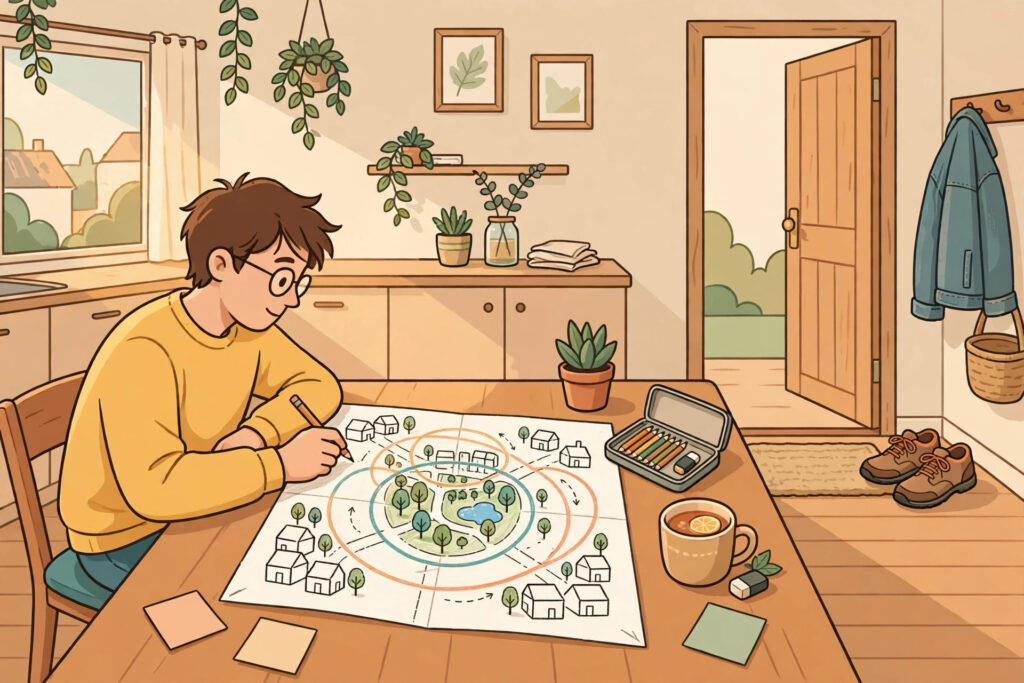
- Start with a home loop. Your first routes should begin and end at your front door, so no driving or planning stands between you and starting. A 10-minute out-and-back (5 minutes out, turn around) is the perfect week-one route because it auto-adjusts: as you get fitter, the same minutes simply take you farther.
- Prefer even, well-lit surfaces while you learn. Sidewalks, park paths, and quiet residential streets let you focus on rhythm instead of footing. Save uneven trails for when your ankles and confidence have had a few weeks of practice.
- Have three lengths ready. A short loop for tired days, your standard loop, and a longer weekend route. Deciding between three known routes takes seconds; inventing one from scratch at walk time is how walks get skipped.
- Notice the pleasant details. A route past gardens, water, or a good view is not a luxury — enjoyment is the engine of consistency. The “best” route is the one you look forward to.
Staying safe on every walk:
- Be visible. In low light or bad weather, wear bright colors and something reflective, and walk facing traffic where there is no sidewalk, so you can see vehicles coming.
- Tell someone your route. A quick message — “walking the river loop, back by seven” — plus your phone on you, covers most situations. Walking with a partner or a dog adds safety and, conveniently, accountability.
- Respect the weather. Heat calls for earlier or later walks, shade, and water; ice and heavy rain call for the indoor backup plan later in this guide, not for bravery. Check the forecast before you lace up, not after.
- Keep one ear open. Music and podcasts make walks fly by, but keep the volume low or use one earbud so you can hear traffic, cyclists, and your surroundings.
- Trust discomfort. If a street, underpass, or situation feels wrong, change route. Your routine has three routes for a reason.
Your Simple 4-Week Walking Plan
Here is the whole program on one page. It assumes you can currently walk for about five minutes without discomfort. If even that is a stretch, spend two weeks at the Week 1 level first — the plan bends to fit you, not the other way around.
Two ground rules apply to every week. First, every walk begins with 2–3 minutes of noticeably slower walking as a warm-up and ends the same way as a cool-down; cold muscles and joints appreciate the courtesy, and your heart prefers a ramp to a switch. Second, gentle stretching after your cool-down — while muscles are warm — helps you stay comfortable as the minutes grow; our companion guide on how to start a morning stretching routine for beginners gives you a simple set of movements that doubles perfectly as a post-walk routine.
Week 1: Just start — 5 to 10 minutes, 4–5 days. Walk 5–10 minutes a day on four or five days of the week, at an easy-to-moderate pace where conversation is effortless. How it should feel: almost too easy. You finish thinking “I could have done more” — that is exactly right. This week is not about fitness; it is about teaching your brain that walks happen, your shoes live by the door, and the route exists. If one route gets dull, swap routes, not goals.
Week 2: A little longer — 12 to 15 minutes, 5 days. Nudge each walk to 12–15 minutes, five days this week. Use the talk test and spend most of each walk at “can talk, can’t sing” pace. How it should feel: pleasantly working — breathing a bit deeper, maybe a light warmth in your legs, fully recovered within minutes of finishing. If a particular day feels heavy, keep the minutes but let the pace drop; showing up easier beats skipping entirely.
Week 3: Building the habit — 18 to 22 minutes, 5 days. Walks grow to roughly 18–22 minutes, still five days. This is the week the routine either becomes “something I do” or quietly negotiates itself away, so protect your scheduled times like appointments. Add one small variation if you like: a route with a gentle hill, or two or three one-minute slightly-faster bursts inside the walk, returning to normal pace between them. How it should feel: like real exercise now, but sustainable — you could keep going at the end, and you are breathing too hard to sing the whole way.
Week 4: Your first half hour — 25 to 30 minutes, 5–6 days. Build to 25–30 minutes on five or six days. Most of the walk sits at talk-test pace, with your warm-up and cool-down bookending it. How it should feel: satisfyingly solid. You finish warm, a little tired in a good way, and — the real marker of progress — the route that felt long in week one now feels ordinary. Congratulations: you have a walking routine.
After week 4: Hold 30 minutes most days for a couple of weeks and let it settle into your life. From there, progress one lever at a time — a few more minutes, a sixth or seventh day, a hillier route, or slightly brisker bursts — never everything at once. That is how a beginner routine quietly becomes a lifelong one.
Making It Stick: Cues, Tracking, and Small Tricks
Motivation starts routines; systems keep them. The walkers still going in month three are rarely the most inspired — they are the ones who made walking the path of least resistance.
Anchor the walk to something that already happens. Habits attach best to existing cues: after morning coffee, right after lunch, the moment you get home, while the kids are at football practice. “After lunch, I walk” survives busy days far better than “sometime today, I’ll walk,” because the cue fires whether or not you feel motivated.
Make starting embarrassingly easy. Shoes and jacket by the door. Route already chosen. Calendar block already set. Every small decision you remove in advance is one less chance for the day to talk you out of it. Laying out your walking clothes the night before works for exactly the same reason it works for runners.
Track it — simply. A tick on a calendar, a note in your phone, or a free step-counter app: all work. Tracking is not about the numbers; it is about the visible chain of days you do not want to break, and about honest feedback — many beginners are surprised to find they walk more, and feel better, than they thought. Count minutes walked per week, since that is what the plan is built on.
Recruit the world a little. A walking partner, a dog, a neighbor who expects you at the corner at seven, a podcast that only plays during walks — each adds a small pull toward the door. And treat the walk as part of looking after yourself rather than another chore; it pairs naturally with the small, deliberate kindnesses in our guide on how to start a self-care routine at home, and framing it that way makes it far easier to defend against a crowded schedule.
Plan the comeback, not just the streak. You will miss days — illness, travel, weather, life. The routine does not die from a missed Tuesday; it dies from “well, that’s ruined” thinking. The rule is simple: never miss twice in a row if you can help it, and when you return, return at a slightly easier level for a day or two rather than punishing yourself with the full distance.
Bad-Weather and Low-Energy Days: The Backup Plan
The difference between a routine and a rough patch of good intentions is what happens on the bad days. Decide your fallbacks now, while you are motivated, so a rainy Tuesday requires no decision at all.
Shorter still counts. A 5-minute walk on a dreadful day preserves the habit, the cue, and the streak — and often turns into 10 once you are out the door. The all-or-nothing mindset is the enemy; a short walk is a kept promise, not a failed one.
Move it indoors. Plenty of walking needs no outdoors at all:
- Mall or large-store walking. Big indoor spaces offer flat, climate-controlled laps; go early to avoid crowds.
- Walk your own home. Hallways, stairs taken gently, and laps during phone calls add up — “walking meetings” work just as well around a kitchen table route.
- Indoor walking videos. Free follow-along walking workouts online let you walk in place in a living room, at beginner pace, with the weather irrelevant.
- Treadmill, if you have access. Keep the incline low and the pace at talk-test level; hold the rails only if balance requires it, since rail-holding changes your natural stride.
Adjust the inputs on low-energy days. Tired is information, not failure. Walk slower, choose the flat route, and let the talk test be the boss: an easy 15 minutes at gentle pace still counts fully toward your week. What you should not do is borrow energy from tomorrow with an exhausting make-up session — consistency across the week beats heroics on any single day.
One exception: if you are ill — fever, a chesty cough, the kind of tired that comes with being genuinely unwell — rest is the correct workout. Resume with a few easy days when you are better, exactly as the safety section advised.
A Quick Health Note Before the Questions
Everything in this guide is general wellness information, shared to help you build a gentle walking habit — it is not medical advice, and it is not a substitute for guidance from your own doctor or another qualified health professional who knows your history. If anything here conflicts with advice you have been given personally, follow your clinician. You can read more about how this site handles health topics on our Disclaimer page.

Frequently Asked Questions
How long should a beginner walk each day?
Start with 5–10 minutes a day, four or five days a week, and add a few minutes each week. By week four of the plan in this guide, most beginners are comfortably walking 25–30 minutes on five or six days. There is no single magic number — the right daily amount is the one you can repeat tomorrow, and consistency matters more than any particular total.
Is walking 30 minutes a day enough exercise?
For a beginner, absolutely — it is a genuinely meaningful amount. Health authorities generally encourage adults to build toward regular moderate-intensity activity across the week, and a daily 30-minute brisk walk gets you a large part of the way there. More is fine as you get fitter, and splitting the time into shorter walks across the day also counts. What matters most is that the activity is regular and sustainable.
What is a good walking pace for a beginner?
The pace where you pass the talk test: breathing harder than at rest, able to speak in full sentences, but unable to sing. For most beginners that lands somewhere around a purposeful, brisk walk rather than a stroll — but the exact speed varies with fitness, terrain, and the day. Judge by effort, not by anyone else’s numbers, and let hills slow you down without worrying about it.
Should I walk every day, or take rest days?
Walking is gentle enough that most beginners can walk daily once they have built up gradually, and the plan above keeps two lighter or rest days in the early weeks. Listen to your body: mild tiredness is fine, but lingering joint pain, foot pain, or exhaustion that does not lift means insert an extra rest day and rebuild more slowly. There is no prize for the longest unbroken streak — only for still walking in six months.
What if I miss a week of my walking routine?
Simply restart where you left off, minus a step: return at the previous week’s minutes and easier pace for two or three walks, then continue the plan. Fitness fades slowly, and the habit returns quickly when the comeback is gentle. Missed weeks happen to every long-term walker; they only end routines when they are treated as failures instead of weather.
Conclusion
Starting a walking routine does not require a transformation, a shopping list, or a heroic first week. It requires a pair of shoes by the door, ten honest minutes, and a plan gentle enough that you are still following it when the novelty wears off — which is precisely what the four weeks above give you.
Start this week at five to ten minutes. Use the talk test, keep your stride comfortable, pick routes you enjoy, and let bad days shrink the walk instead of cancelling it. A month from now, that daily half hour will not feel like exercise you have to do. It will feel like your time — and that is a habit worth keeping.
You will find more beginner-friendly guides like this one in our Health and Personal Care category, all written to help you build a healthier day one small, sustainable habit at a time.