How to Start a Morning Stretching Routine for Beginners: 8 Simple Moves
Almost everyone knows the feeling: the alarm goes off, you sit up, and your neck, shoulders, and your lower back feel like they belong to someone ten years older. That morning stiffness is completely normal — after hours of stillness in bed, your muscles are cool, your joints have barely moved, and your body needs a few minutes to warm up and get going. The good news is that you do not need an hour of exercise or a gym membership to shake it off. A short, gentle routine — five to ten minutes in your bedroom or living room — is enough to help most people feel looser and more comfortable as they start the day.
Table of Content
- Why Mornings Feel Stiff (And What Gentle Stretching Can Honestly Do)
- Safety First: The Rules That Keep Stretching Gentle
- What You Need (Almost Nothing)
- Move 1: Neck Release — Tilts and Slow Turns
- Move 2: Shoulder Rolls and Shrugs
- Move 3: Chest Opener — Hands Clasped Behind Your Back
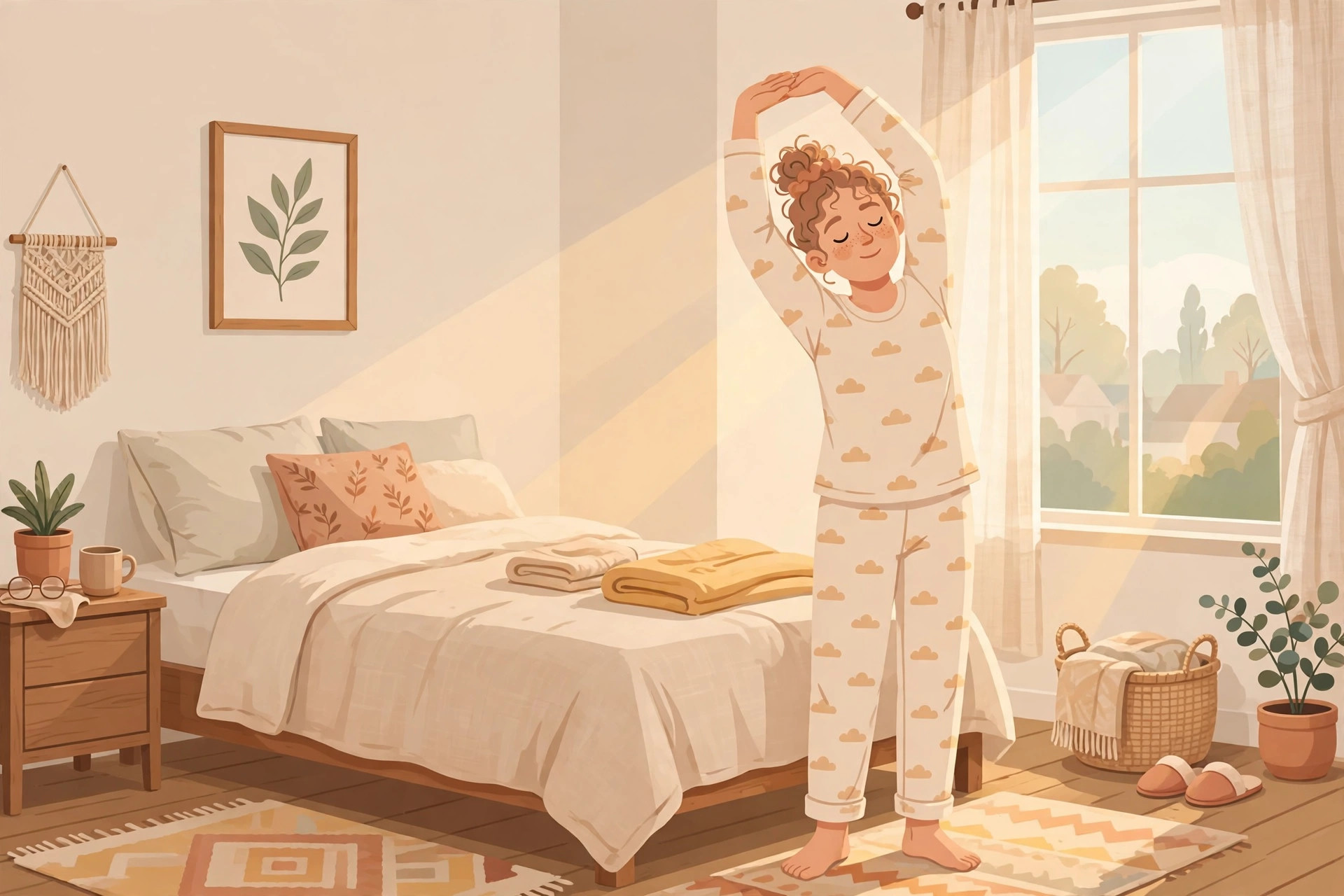
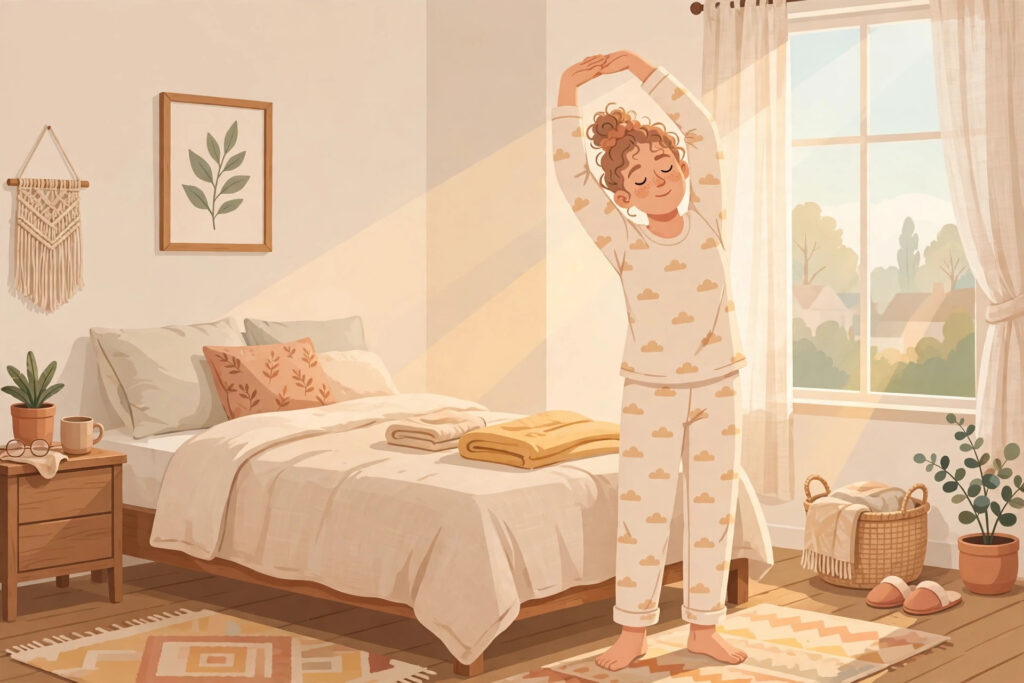
- Move 4: Standing Side Stretch
- Move 5: Cat-Cow — The Gentle Spine Wake-Up
- Move 6: Standing Forward Fold
- Move 7: Gentle Standing Twist
- Move 8: Calf Stretch at the Wall — And Ankle Circles to Finish
- The 3-Minute Express Routine: For Mornings That Go Wrong
- Your First Week: A Simple 7-Day Starter Plan
- How to Turn Five Minutes Into a Habit That Sticks
- A Short Health Note Before the Questions
- Frequently Asked Questions
- How long should a beginner hold each stretch?
- Is it okay to stretch first thing in the morning, before doing anything else?
- Should stretching hurt if it is working?
- How soon will I notice a difference?
- Can I do this routine every day?
- What if I am not flexible at all — is this still for me?
- Conclusion
This guide shows you exactly how to start a morning stretching routine for beginners, even if you have never stretched on purpose in your life. You will learn eight simple moves, each explained step by step with hold times and easier variations, plus the safety rules that keep stretching comfortable instead of harmful. There is also a three-minute express version for rushed mornings, a simple seven-day starter plan, and honest advice on turning this into a habit that sticks. No equipment, no experience, no flexibility required.
Why Mornings Feel Stiff (And What Gentle Stretching Can Honestly Do)
Let us be honest about what stretching is and is not, because the internet oversells it. Stretching is not a cure for anything, and a week of morning stretches will not fix a medical problem. What gentle, regular stretching can do — and what health authorities such as the NHS and Mayo Clinic consistently describe — is help you maintain and gradually improve your flexibility and range of motion, so everyday movements like tying your shoes or reaching a high shelf feel easier over time. The Mayo Clinic’s stretching guide notes that better flexibility may improve performance in daily activities and decrease injury risk during exercise — modest, real benefits, earned gradually.
Morning is a particularly good time to collect those benefits. It addresses the stiffness you actually feel, instead of letting it linger into your commute or desk chair; it is the easiest time slot to protect, before the day fills up with other people’s demands; and gentle movement wakes you up in a way scrolling your phone does not — most people feel more alert by the last stretch than they did at the first.
Set your expectations at the right level and you will enjoy this far more. In week one, the win is simply doing it and feeling a little looser by breakfast. Over a few weeks of most mornings, many beginners notice they can reach a little further and get out of bed with less of that creaky first minute. That is the honest promise of morning stretching — small, steady, real.
Safety First: The Rules That Keep Stretching Gentle
Stretching is one of the lowest-risk forms of movement there is — but only when done gently. Most stretching injuries come from treating it like a competition: forcing a position, bouncing into it, or pushing through pain because a video made it look easy. Read these rules before your first session.
- Warm up before you stretch deeply. Your muscles are stiffest first thing, so never launch straight into your deepest stretch. Walk around for a minute, make tea, brush your teeth — then begin with the smallest moves (this routine is ordered that way on purpose, starting with the neck and shoulders).
- Never bounce. Move into each stretch slowly until you feel mild tension, then hold still. Bouncing can strain muscles and makes them tighten in response — the opposite of what you want.
- Stretch to tension, never to pain. The right intensity is a gentle pull, maybe a 3 or 4 out of 10. Sharp, stabbing, burning, or joint pain means stop — come out of the stretch immediately. Mild discomfort in a tight muscle is normal; pain is not.
- Keep breathing. Slow, steady breaths are part of the stretch. If you are holding your breath, you have gone too far — ease off until you can breathe comfortably.
- Move slowly in and out. Jerky movements and sleepy bodies do not mix.
- Use support without embarrassment. A wall, a chair back, or a bed edge for balance is not cheating — it is how sensible beginners stretch.
Check with a doctor or physiotherapist first if any of these apply to you: a recent injury, surgery, or fracture that is still healing; pregnancy (some positions need adjusting); a joint condition such as arthritis, a joint replacement, osteoporosis, or a diagnosed back or neck problem; or dizziness, numbness, or pins and needles when you move your neck or back. A professional who knows your situation can say which moves to keep, modify, or skip.
The same caution applies mid-routine: if any move produces sharp pain, tingling, or dizziness, skip it. Seven gentle moves will serve you far better than eight with one that hurts.
What You Need (Almost Nothing)
A morning stretching routine has almost no shopping list:
- A small patch of floor — room to stand with arms outstretched and, for one move, to kneel. A carpet, rug, or folded towel under your knees is all the padding most people need.
- Comfortable clothes — pyjamas are genuinely fine. Anything that lets you raise your arms and bend without a waistband digging in.
- Bare feet or non-slip socks — smooth socks on hard floors are a slip waiting to happen.
- A wall and a chair nearby for balance and for the calf stretch.
- A phone timer (optional) — helpful in week one, unnecessary once the routine is in your body.
That is the whole list. If a routine needs a purchase before day one, it is a sales pitch, not a beginner routine.
Move 1: Neck Release — Tilts and Slow Turns
After a night in whatever position your pillow allowed, the neck is usually the stiffest part of the body — and the gentlest place to begin, which is why this routine starts here.
What it is: A slow, small-range stretch for the sides and back of the neck. You are not trying to touch your ear to your shoulder — just reminding the neck, politely, that it moves.
How to do it, step by step:
- Stand tall (or sit on the edge of the bed), feet hip-width apart, shoulders relaxed down away from your ears.
- Slowly tilt your right ear toward your right shoulder until you feel a mild stretch along the left side of your neck. Keep the shoulder itself down — the ear travels, the shoulder stays.
- Hold, breathing slowly, then return to centre even more slowly than you left it.
- Repeat on the left side.
- Then turn instead: rotate gently to look over your right shoulder, hold, return to centre, and repeat to the left.
Hold time: 10–15 seconds per tilt, 2 tilts per side; 10 seconds per turn, 2 turns per side. About one minute in total.
Make it easier: Shrink the movement — halfway to the full tilt is a perfectly good stretch, and seated on the bed is a perfectly good place to do it. If turning your head makes you dizzy, do the tilts only and skip the turns until you have checked with a professional.
Move 2: Shoulder Rolls and Shrugs
Shoulders carry the night’s tension and, for most people, the whole previous day’s as well. This move pairs a deliberate shrug with slow rolls, teaching the muscles the difference between holding tension and letting it go.
What it is: A mobility move rather than a deep stretch: big, slow circles for the shoulder joints, plus a squeeze-and-release for the tight muscles across the top of the shoulders.
How to do it, step by step:
- Stand tall with your arms hanging loose by your sides.
- Inhale and lift both shoulders up toward your ears as high as they will comfortably go. Hold the squeeze for 3–5 seconds — feel how deliberate tension feels.
- Exhale and let them drop completely, as if putting down two heavy bags. That dropped feeling is the goal of this whole move.
- Repeat the shrug and drop twice more.
- Now roll them in big slow circles — up, back, down, around — 5 times, then reverse for 5 more.
Hold time: 3 shrugs of 3–5 seconds, then 10 slow rolls. About one minute.
Make it easier: Do it seated, with smaller circles. If one shoulder is grumpy, roll the comfortable one fully and the sore one through whatever smaller circle feels fine.
Move 3: Chest Opener — Hands Clasped Behind Your Back
A tight chest pulls your shoulders forward — in bed, at a desk, everywhere. Opening the front of the shoulders is one of the simplest ways to stand a little straighter all day, and the first habit to build if you spend long hours sitting, as our guide on how to improve your posture at a desk explains in more depth.
What it is: A standing stretch for the chest and the fronts of the shoulders, hands clasped behind you. No equipment required.
How to do it, step by step:
- Stand tall and clasp your hands together behind your back, fingers interlaced. If they will not meet today, hold a small towel between them instead.
- Gently straighten your arms and lift your hands a few centimetres away from your back — only until you feel a mild stretch across your chest.
- Lift your chest slightly and look straight ahead.
- Breathe slowly and let the stretch settle; resist the urge to lean forward.
- Release gently and shake your arms out.
Hold time: 20–30 seconds, repeated twice. About one minute.
Make it easier: Keep your arms slightly bent and your hands resting against your lower back without lifting them. You should still feel a gentle opening across the chest — that counts, fully.
Move 4: Standing Side Stretch
This is the stretch your body already wants to do — that big overhead reach people do instinctively when they get out of bed. Done slowly, it lengthens the whole side of the body: ribs, waist, and the long muscles of the back.
What it is: A standing side bend with one arm overhead, stretching the side of the torso — it may become your favourite part of the routine.
How to do it, step by step:
- Stand with your feet hip-width apart and your knees soft, not locked.
- Raise your right arm up toward the ceiling, long and relaxed.
- Slowly lean to the left, left hand sliding down your thigh. Reach up and over, like a rainbow, rather than collapsing sideways.
- Keep both sides long — imagine your raised hand being gently pulled away from your hip.
- Breathe into the stretch, come back up slowly, and repeat on the other side.
Hold time: 15–20 seconds per side, twice per side. About one minute.
Make it easier: Keep the free hand on your hip and lean just a few centimetres — a tiny lean done daily beats a dramatic one done weekly. If you feel unsteady, do it beside a wall or chair.

Move 5: Cat-Cow — The Gentle Spine Wake-Up
If you only ever learn one floor move, make it this one. Cat-cow moves the spine slowly through its full comfortable range — rounding, then arching — and beginners often call it “the one that unlocks my back in the morning.” Harvard Health’s overview of stretching makes the same point this routine is built on: regular gentle stretching keeps muscles flexible and joints moving through their full range.
What it is: A slow, flowing movement on all fours, alternating between rounding your back toward the ceiling (the cat) and letting it soften downward (the cow). There is no long hold — the movement itself is the stretch.
How to do it, step by step:
- Come onto all fours: hands under shoulders, knees under hips, back flat like a table. A folded towel under your knees makes this much friendlier.
- Cow: Inhale, let your belly soften toward the floor, lift your chest and tailbone slightly, and look gently forward. Keep the arch modest.
- Cat: Exhale, press the floor away, and round your back toward the ceiling, head dropping, tailbone tucking under.
- Flow between the two, led by your breath: inhale into cow, exhale into cat. Move so slowly that a watcher would find it boring.
- After your final round, sit back on your heels for two breaths, then stand up slowly.
Hold time: 6–8 slow rounds, roughly one minute. If it feels good, 10 rounds is fine.
Make it easier: Do it seated instead — feet flat, hands on knees, gently rounding and arching your back in the chair — or standing with hands on your thighs. If getting down to the floor is difficult right now, skip this move and give Move 7 an extra round; the routine works without it.
Move 6: Standing Forward Fold
The fold is the classic morning stretch for the back of the body — hamstrings, calves, and lower back — and the one beginners most often perform badly, hauling themselves down with straight knees and a rounded back. Done the gentle way below, it is simple and deeply satisfying.
What it is: A standing fold over your own legs, soft knees and a long spine, letting gravity do the work your hands should never force.
How to do it, step by step:
- Stand with feet hip-width apart and bend your knees generously — bent knees are the rule here, not a failure.
- Hinge forward from your hips, keeping your chest long, until your hands rest on your thighs, shins, or the floor — wherever they land honestly.
- Let your head hang heavy and your arms dangle or hold opposite elbows.
- Breathe, letting your back soften with each exhale. Sway gently side to side if that feels good.
- To come up: bend your knees a little more, place hands on thighs, and unroll slowly to standing, head last.
Hold time: 30–45 seconds, repeated twice. About ninety seconds.
Make it easier: Rest your hands on a chair seat or the edge of the bed and fold only halfway, back flat — the “tabletop” version gives most of the benefit with far less intensity. Anyone with low-back problems, or who gets dizzy bending over, should use this version or skip the move.
Move 7: Gentle Standing Twist
Twisting is the movement daily life asks of you constantly — turning in the car, reaching behind you — and the one a stiff morning body resists most. This slow standing version coaxes the rotation back without asking anything risky of your spine.
What it is: A controlled rotation of the torso while the hips stay facing forward, stretching the muscles around the spine.
How to do it, step by step:
- Stand with feet hip-width apart and cross your arms over your chest, hands on opposite shoulders — this gives your torso one solid piece to rotate.
- Keeping your hips facing forward (headlights on your hip bones, pointing straight ahead), slowly turn your chest and head to the right.
- Stop at the first point of comfortable resistance. Your eyes can look a little further than your chest turns; your hips should not follow.
- Breathe once or twice, return to centre just as slowly, and repeat to the left.
- If your balance wobbles, rest one hand on a chair back.
Hold time: 15–20 seconds per side, twice per side. About ninety seconds.
Make it easier: Seated on a sturdy chair — feet flat, twist gently holding the chair’s side for leverage, movement small. Anyone with a diagnosed back condition should get professional advice before adding twists.
Move 8: Calf Stretch at the Wall — And Ankle Circles to Finish
Your calves do the first work of the day — the stairs, the standing at the kettle — and they are famously tight in the morning. This final move uses a wall for support, then ends the routine by waking up your ankles.
What it is: A wall-supported stretch for the back calf, followed by slow ankle circles that take the ankle through its full, friendly range.
How to do it, step by step:
- Stand facing a wall, palms flat against it at shoulder height.
- Step your right foot back about two foot-lengths, toes pointing forward, and press that heel firmly into the floor.
- Bend your front knee and lean gently toward the wall until you feel a stretch in the back calf. Keep the back leg straight, hips facing the wall.
- Hold, breathing. If you feel nothing, step the back foot a little further away rather than leaning harder.
- Switch sides. Then, holding the wall, lift one foot and draw 5 slow circles with your toes in each direction; repeat on the other foot.
Hold time: 20–30 seconds per calf, twice per side, plus about 30 seconds of ankle circles. Around ninety seconds — and the routine is done.
Make it easier: Take a smaller step back and a shallower lean; the stretch should feel mild enough to chat through. Ankle circles can also be done seated on the bed before you stand up — a lovely way to begin on very stiff days.
That is the full routine: eight moves, roughly eight to ten minutes. In week one it will take a little longer while you re-read instructions; by week two, your body will know the order.
The 3-Minute Express Routine: For Mornings That Go Wrong
Some mornings, ten minutes does not exist — the alarm failed, the meeting moved earlier. On those days the choice is between three minutes and nothing, and three minutes wins easily. Do these four moves, once each, at the standard hold times:
- Move 2 — Shoulder rolls and shrugs (the fastest wake-up in the set).
- Move 4 — Standing side stretch, one round per side.
- Move 6 — Standing forward fold, one 30-second hold.
- Move 8 — Calf stretch, one hold per side.
Then get on with your day without guilt. A routine you shorten is a routine that survives; one you skip because the “proper” version felt impossible quietly dies by Thursday. The express version is the habit’s safety net.
Your First Week: A Simple 7-Day Starter Plan
Do not aim for a perfect performance on day one. Aim to still be stretching on day seven.
Day 1 — Learn the shapes. Do moves 1–4 only (neck, shoulders, chest, side stretch), slowly, re-reading instructions as needed. About five minutes. This is a learning day, not a performance.
Day 2 — Repeat and settle. Moves 1–4 again, at the easier variations if you used them. Notice which side of your body is stiffer — most people have one.
Day 3 — Add the floor. Add Move 5 (cat-cow) and Move 6 (forward fold) — seated cat-cow if kneeling is not for you. Now six moves, about seven minutes.
Day 4 — Full set, gentle holds. Add Move 7 (twist) and Move 8 (calves and ankles). Do the complete routine, keeping every hold at the shorter end of its range — that is the whole thing.
Day 5 — Full set, standard holds. The complete routine at the hold times written above — it should feel familiar now, in close to ten minutes.
Day 6 — Your choice. Full routine, or the 3-minute express version if the morning is chaos. Choosing the short version on purpose is a skill worth practising — it is the skill that saves the habit later.
Day 7 — Rest or repeat. Rest completely if your body asks for it, or repeat the full routine and note one honest sentence about how your mornings feel compared with day one.
After week one, simply repeat the full routine on most mornings, using the express version whenever life requires it. Nothing needs to get harder or longer for this to keep working — consistency is the entire programme.
How to Turn Five Minutes Into a Habit That Sticks
The stretches are the easy part. The real project — the one that decides whether you feel any different in a month — is showing up on ordinary, unmotivated mornings. These tricks work for most beginners:
Attach it to something you already do. Habits survive by piggybacking: stretch after brushing your teeth, while the kettle boils, or after making the bed — pick one anchor and keep it fixed. “After I brush my teeth, I stretch” is a plan; “sometime this morning” is a wish.
Make the start effortless. Same spot, same order, same first move, every day. Decisions drain motivation; a routine you can begin on autopilot asks almost nothing of your willpower. Leave a folded towel in that spot as a silent cue.
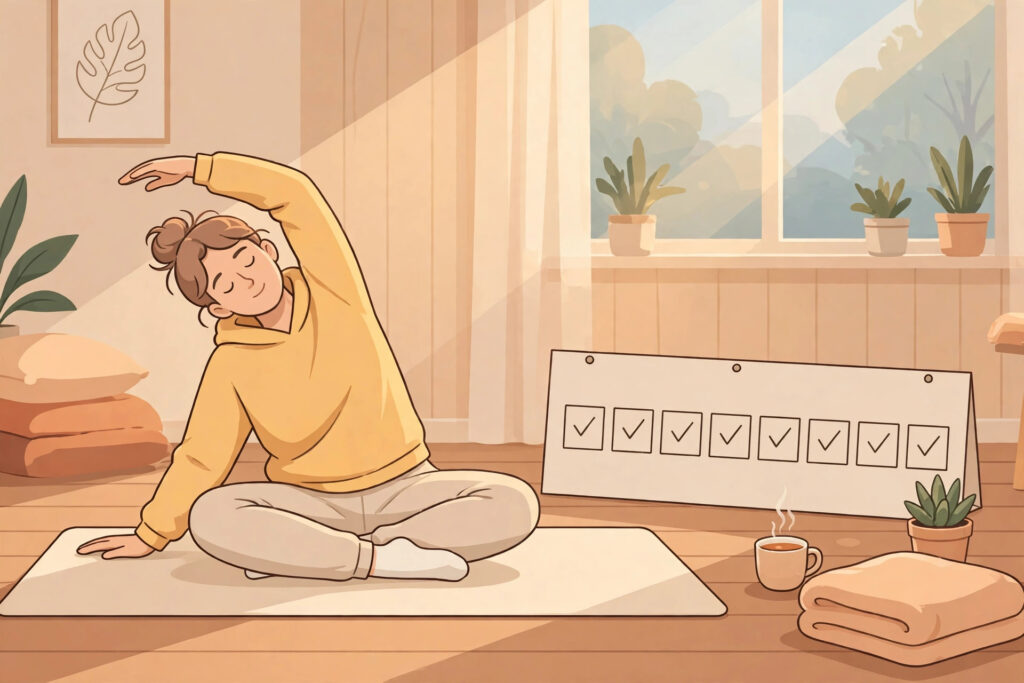
Track streaks, kindly. A tick on a calendar for every morning you stretch — full or express version — is strangely motivating, and watching the line grow makes skipping feel expensive. When you miss a day, the rule is simple: never miss twice. The habit only breaks when a miss becomes the new pattern.
Pair it with a bigger morning. Once stretching feels automatic, it becomes a natural doorway into a slightly longer routine: a short walk afterwards, for instance. If that sounds appealing, our guide on how to start a walking routine for beginners builds one just as gently — start embarrassingly small, and let consistency do the work.
Let it be self-care, not a chore. For many readers, these quiet minutes become the calmest part of the day — no phone, no demands, just breathing and moving. To build that feeling into a wider routine, our guide on how to start a self-care routine at home shows how small, kind habits combine into something restorative. For general guidance on building activity into daily life, the NHS Live Well exercise pages are a trustworthy next read.
A Short Health Note Before the Questions
The NHS guide to flexibility exercises and the other sources linked here agree on the essentials this routine follows: warm up first, stretch gently, never force a movement. Even so, an important disclaimer: everything in this article is general wellness information for healthy adults, not medical advice. It does not diagnose, treat, or replace the guidance of your own doctor or physiotherapist, and it cannot know your body, your history, or your medications. If anything here conflicts with advice you have been given by a professional who knows you, their advice wins — every time. Please also read our Disclaimer for how this site approaches health topics.

Frequently Asked Questions
How long should a beginner hold each stretch?
For most static stretches, 15–30 seconds is the standard beginner range, and every move in this routine sits inside it. Shorter holds (10–15 seconds) suit the neck, where gentleness matters more than duration, and flowing moves like cat-cow replace holds with slow repetitions. Repeat each stretch twice per side rather than holding once for a long time — two comfortable holds loosen you up better than one strained one.
Is it okay to stretch first thing in the morning, before doing anything else?
Yes, with one condition: start small. Your muscles are cool and stiff after sleep, which is why this routine begins with the neck and shoulders rather than the deepest stretches, and why the safety rules come first. Walk around for a minute and splash water on your face — that minute of ordinary movement is all the warm-up a gentle routine needs. Save genuinely deep stretching for later in the day, when your body is warm.
Should stretching hurt if it is working?
No — this is the most important misunderstanding to retire. A working stretch feels like mild tension in the belly of a muscle, a pulling sensation you could hold a conversation through. Sharp pain, joint pain, burning, tingling, or numbness are never signs of progress; they are stop signals. If a move hurts, come out of it, try the easier variation, and skip it if it still hurts. Progress comes from hundreds of gentle repetitions, not a few painful ones.
How soon will I notice a difference?
Most beginners feel a small difference immediately — the contrast between sitting up stiff and how you feel after ten minutes of movement. Lasting changes are slower: over two to four weeks of most-mornings practice, people commonly notice they reach a little further in the forward fold and turn their head more easily. Nobody can promise you a timeline, but consistency matters far more than intensity — which is why this guide spends as much time on habits as on stretches.
Can I do this routine every day?
For most healthy adults, yes — gentle stretching at this intensity is generally considered suitable for daily practice, and daily is how morning routines build into habits. Listen to your body over any article, though: if a muscle feels sore from yesterday, give that move a rest day and do the others. Three or four mornings a week still delivers most of the benefit.
What if I am not flexible at all — is this still for me?
You are exactly who it is for. Every move here assumes a stiff, ordinary, beginner body — bent knees are built into the instructions, supported versions are offered throughout, and nothing asks you to touch your toes or resemble a fitness video. Flexibility is the result of routines like this, practised gently over time; it has never been the entry requirement.
Conclusion
Learning how to start a morning stretching routine for beginners requires no talent, equipment, or free hour — just eight gentle moves, a few safety rules you actually follow, and a time slot small enough to defend: five to ten minutes between waking and the rest of your life. Start with the first four moves tomorrow, add the rest across your first week, use the three-minute version whenever the morning fights back, and let an unbroken-enough streak do what motivation alone cannot.
Your mornings do not have to begin stiff and already behind. Begin them with a neck release, a deep breath, and a body that feels like yours again. You will find more gentle, beginner-friendly guides like this one in our Health and Personal Care category, all written for people building healthier days one small habit at a time.